The File
Ace Hotel & Swim Club Athens
Design-led hotel and swim club · Glyfada, Athens Riviera
A Brutalist block from the 1970s reworked by a French studio, with a bistro and two pools. The most interesting of the coast's recent arrivals because it is not a resort.
Commercial relationship
None. LivingTheta has no commercial relationship with Ace Hotel or its restaurant and receives nothing from them.
- What it is
- Hotel and swim club Atelier Ace. Interiors by the French studio Ciguë.
- Where
- Glyfada Around three minutes on foot from Glyfada beach.
- The building
- 1970s Brutalist An existing structure reworked rather than a new build.
- General manager
- George Tsantirakis Twenty years across Greece, the United Kingdom and the United States.
- Restaurant
- Sebastian French-American bistro with Mediterranean influences.
- Pools
- Two A ground-floor pool and a rooftop.
Of the properties that have opened on the Athens Riviera recently, this is the one that is doing something structurally different. It is not a resort with a beach and a spa. It is a hotel and a swim club inside a Brutalist building from the 1970s, reworked by the French studio Ciguë for Atelier Ace, and it is trying to be a place in Glyfada rather than a place near Glyfada.
The building is the story
A 1970s concrete structure revived rather than replaced is rare here. Almost everything of note that has opened on this coast in the last five years is either new build or a complete reconstruction, and the visual result on the Riviera has become fairly uniform.
Working with an existing Brutalist frame produces something that could not have been built from scratch, and it means the hotel looks like the decade the coast actually grew in. That is a design argument rather than a hospitality one, but on a coastline where the same four addresses have been photographed the same way for a decade it is a genuine difference.
The stated intention
The general manager, George Tsantirakis, has described the philosophy in trade press as a hotel needing to be part of a place rather than merely in it, with the aim of an all-day destination that works for residents of Glyfada as much as for guests.
He has also named the common failure directly: treating the restaurant as an extension of the lobby, a multi-purpose room serving the hotel rather than a venue with its own identity. The strategy he describes runs the other way — each outlet with its own character, investment in design, a programme of chef collaborations and music, and investment in staff.
A hotel restaurant designed to serve the lobby will be used by the lobby. One designed as a restaurant might be used by the town.
Sebastian
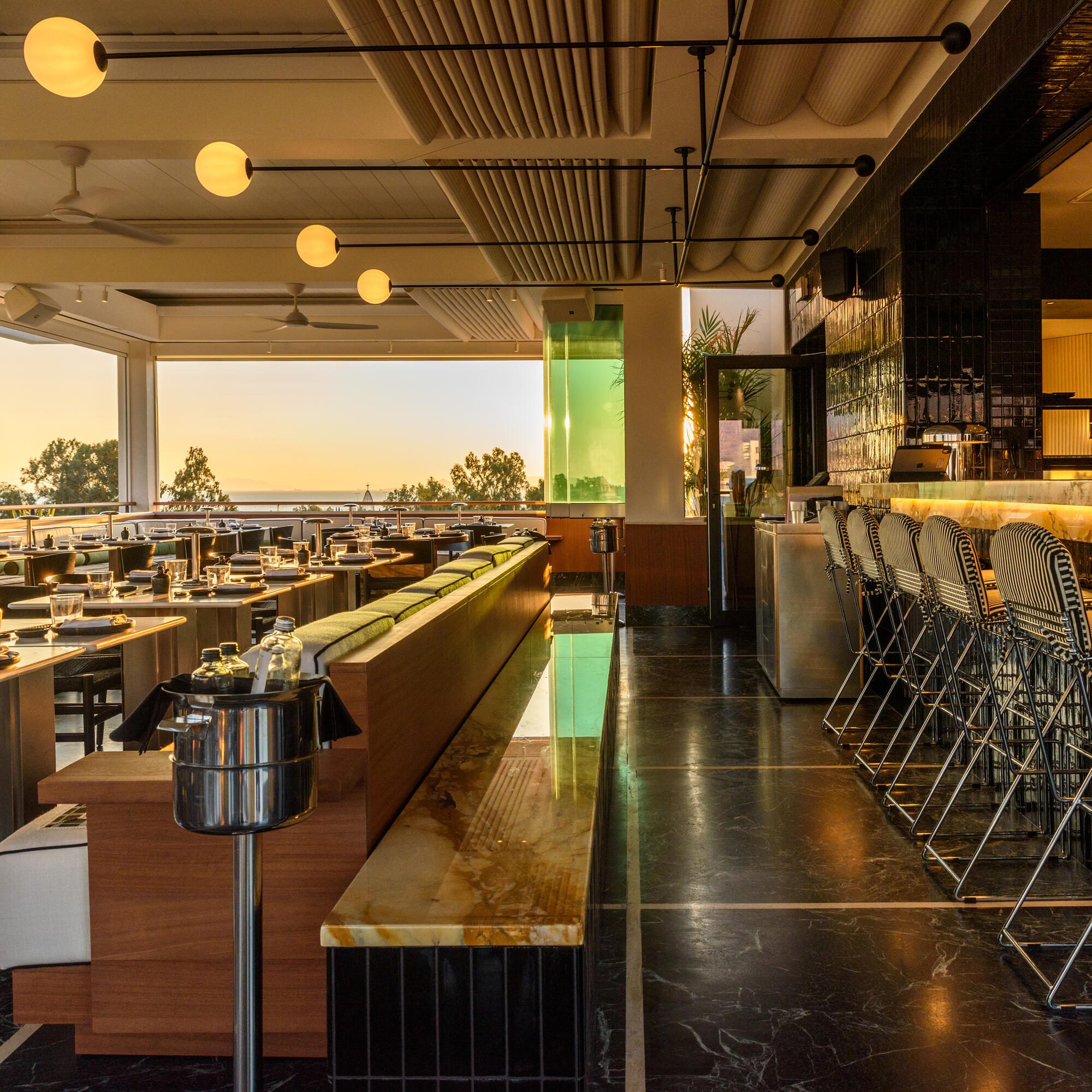
The restaurant is a French-American bistro with Mediterranean influences. We have not eaten there and are not describing the food.
What can be said is that a bistro is a more useful format for a resident than a destination dining room, because it survives being used casually and repeatedly — which is the test that matters in February rather than in July.
The context that makes it plausible
Glyfada is the only one of the four addresses that functions as a town: 89,597 residents, growing while Greece shrank, with a high street that Cushman & Wakefield ranks as Greece's third most expensive permanent retail zone. Permanent being the operative word — multi-year leases, tenants who are there in November.
A hotel betting on residents rather than on season needs exactly that kind of town underneath it, and this is the only part of the coast that supplies one. Whether the bet works is a question for a winter visit, and that visit has not happened yet.
